
Enterprise Footer Strategies for Multi-Domain Sites
Managing footers across multiple domains is more than a design task - it's a challenge that involves branding, compliance, and SEO. Enterprises face three main issues: ensuring consistency, meeting legal requirements like GDPR, and using footers effectively for navigation.
Here are three strategies to tackle these challenges:
Centralized Templates: A single team manages a universal footer template with a mix of global and site-specific elements. This works well for strict consistency but limits local flexibility.
Localized Variants: Combines a fixed global section with customizable local areas. This balances global standards with regional needs but can be harder to scale across many domains.
Programmatic Synchronization: Tools like 1Footer automate updates across domains, ensuring compliance and SEO performance. This requires upfront technical effort but reduces manual work long-term.
Each approach has trade-offs in governance, flexibility, and technical complexity. The right choice depends on your organization's structure and goals.
1. Centralized Template Strategy
The centralized template strategy approaches the footer as shared infrastructure, managed by a single corporate team. This team oversees the template’s content and updates, ensuring consistency across all domains. One major benefit? It solves the issue of "footer drift", where legal links or other critical elements on the main site become outdated or inconsistent on subsidiary domains. This strategy balances strict standardization with the flexibility needed for local adjustments.
To make this work, the footer is divided into two distinct areas:
Universal Zone: This section includes content like global legal links, corporate navigation, and branding elements. These must stay identical across all websites to maintain consistency. For instance, Red Hat’s design system emphasizes this by stating:
"The universal footer should look the same across all Red Hat websites. Do not create your own custom universal footer by changing, deleting, or rearranging any elements."
Website-Specific Zone: This area allows for customization, enabling local teams to add elements like regional social media links, localized logos, or navigation tailored to specific markets.
Automation can further streamline this process. IBM’s Carbon Design System, for example, uses country and language metadata to automatically produce localized footer content, eliminating the need for manual updates and making it scalable across multiple domains.
How the footer is delivered also plays a big role. If delivered via client-side JavaScript or iframes, the footer might not be visible to search engine crawlers, which can harm SEO. On the other hand, server-side rendering or edge-based delivery methods (like Cloudflare Workers) ensure that the footer HTML is part of the initial page load. This keeps internal links crawlable and protects SEO performance across the entire domain portfolio.
To maintain consistency, it’s essential to establish clear guidelines from the start. Define which elements are locked and which can be customized, and clarify who has the authority to make changes. Without proper documentation, local teams might unintentionally modify the universal zone, undermining the overall strategy.
2. Localized Footer Variants Under Global Standards
Using centralized templates can ensure uniformity, but they often fail to meet the specific needs of different regions. To tackle this, many enterprises adopt a two-part footer design: a fixed global section paired with a customizable, localized section. This approach requires governance that is both structured and adaptable. Localized variants, built on centralized strategies, provide the necessary flexibility to address regional demands.
Take Red Hat as an example: they maintain a fixed universal footer that covers 60% of the layout, while the remaining 40% is open for local customization. This localized section allows site teams to incorporate region-specific elements like logos, social media links, and tailored navigation options. Governance here follows a three-tier model: corporate administrators define the global template, regional managers make adjustments for clusters of locations, and domain editors propose further changes for review. As Anyday aptly noted:
"If brand teams cannot self-serve within defined guardrails, your architecture is making IT a bottleneck and your brands are finding ways around it." - Anyday
From a technical perspective, metadata-driven systems can significantly cut down manual work. For instance, IBM's Carbon Design System automates the creation of locale selectors, regional legal links, and additional compliance notes. These features are tailored based on country and language codes embedded in the page metadata.
Different governance structures are influenced by the domain architecture in use. Here's a quick breakdown:
Domain Architecture | Authority Level | Best For |
|---|---|---|
Subdirectory | Consolidated | 5–50 locations under a single brand |
Subdomain | Partially split | Unique sub-brands or region-specific content |
Separate Domain | Fully split | Independent franchises or operations in different countries |
Balancing global standards with local adjustments ensures consistent branding and compliance. This consistency isn't just about aesthetics - it can have a tangible impact. Studies show that unified brand presentation across platforms can increase revenue by up to 23%. Investing in robust governance systems eliminates the need to rely on teams to "remember the rules", ensuring smoother operations and better results.
3. Programmatic Synchronization (e.g., 1Footer)
Enterprises are moving toward programmatic synchronization to simplify footer updates and avoid the hassle of managing them manually across multiple repositories. Instead of juggling updates across various domains, companies are adopting tools like 1Footer to centralize the process. With a single dashboard, teams can synchronize shared infrastructure and push updates seamlessly across all domains.
"1Footer moves that work into a centralized model. You connect each domain once, define brand-level footer data, and publish updates from one dashboard." - Daniel Sinewe, Creator of 1Footer
This process follows a structured lifecycle - draft, review, publish, verify - which ensures every update is audited and compliance gaps are addressed immediately. By adopting this model, businesses can streamline their operations and pave the way for more advanced technical solutions.
Using server-side rendering with edge middleware tools like Cloudflare Workers, companies can deliver domain-specific HTML that supports crawlable internal links, boosting SEO performance. For instance, one site using 1Footer saw its Domain Rating jump from 9 to 16.
The system also employs an inheritance model. It maintains global elements, such as brand messaging and legal links, while allowing room for domain-specific customizations like regional navigation. This strikes a balance between maintaining consistency across the brand and catering to local needs.
The real advantage of this approach lies in its efficiency. By eliminating repetitive, low-value tasks, teams can focus on more impactful work.
"The value is not novelty; it is operational leverage. You keep the implementation model technical and explicit while removing low-value repetition from your release process." - 1Footer
Pros and Cons
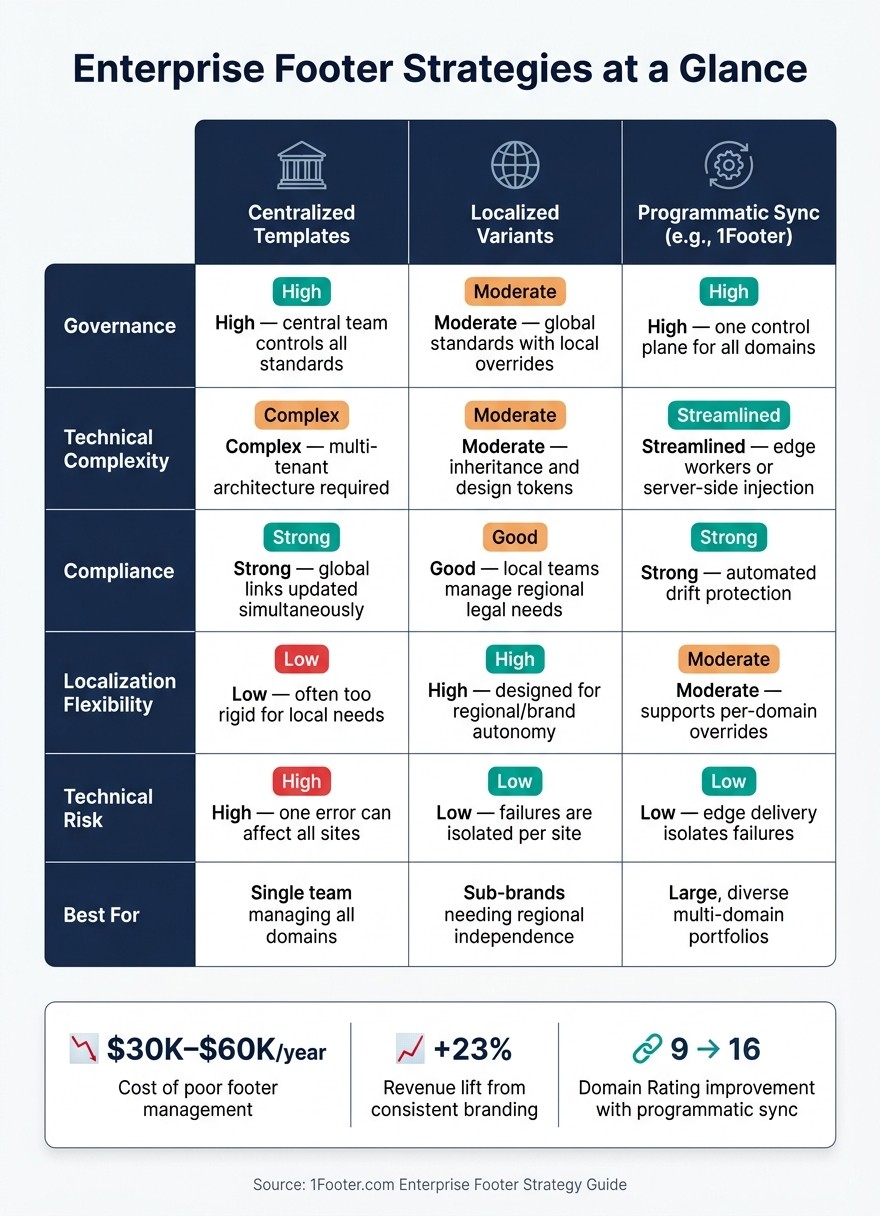
Enterprise Footer Strategies Compared: Centralized vs. Localized vs. Programmatic
Looking at the strategies above, it's clear that each comes with its own set of trade-offs when it comes to domain count, flexibility, and technical complexity.
Centralized Templates: This method excels in governance and compliance. A single update can instantly apply to every domain. However, its rigidity can be a drawback. Local teams can't make site-specific changes without IT's help, and a single misstep in configuration could cause widespread noncompliance. As Anuj Agrawal, Technical Architect at HCL America, aptly stated:
"The hidden cost is not just technical debt. It is organizational drag."
Localized Variants: This flips the script by giving regional teams the freedom they need, while keeping failures isolated. The trade-off here is scalability - managing updates manually across numerous repositories raises the risk of compliance issues. This model often struggles when applied to more than 10 domains.
Programmatic Synchronization: This approach aims to strike a balance between centralized control and domain-specific customization. The downside? It's more complex to implement. Using edge middleware and API-based delivery requires significant upfront technical effort compared to a shared CMS template.
Here's a quick comparison of these strategies across major features:
Feature | Centralized Template | Localized Variants | Programmatic Sync (1Footer) |
|---|---|---|---|
Governance | High; central team controls all standards | Moderate; global standards with local overrides | High; one control plane for all domains |
Technical Implementation | Complex; requires multi-tenant architecture | Moderate; uses inheritance and tokens | Streamlined; uses workers or server-side injection |
Compliance | Strong; global links updated simultaneously | Good; local teams manage regional legal needs | Strong; automated drift protection |
Localization Flexibility | Low; often too rigid for local needs | High; designed for regional/brand autonomy | Moderate; supports per-domain overrides |
Technical Risk | High; one error can affect all sites | Low; failures are isolated per site | Low; edge delivery isolates failures |
These comparisons highlight how critical footer management strategy is for ensuring consistent branding, regulatory compliance, and operational efficiency across enterprise domains. Mistakes in this area can be costly. Maintaining enterprise-scale web properties can cost $30,000–$60,000 annually, and inconsistent branding can directly hurt revenue. In fact, consistent branding across all platforms has been shown to increase revenue by 23%. This makes footer governance not just a technical challenge, but a key business decision.
Conclusion
The best footer strategy depends on your organization's structure, technology, and how much regional flexibility you need. If a single team can handle updates, centralized templates are ideal. For sub-brands that need some independence while adhering to global standards, localized variants work well. And for large, diverse portfolios, programmatic synchronization is the way to go. These decisions can directly affect both your finances and operations.
Poor footer management can cost companies between $30,000 and $60,000 annually, with outdated links adding compliance headaches.
For teams stuck with manual, error-prone updates, a centralized tool can simplify the process. Daniel Sinewe, founder of 1Footer, explained the inspiration behind the platform:
"1Footer exists because I got tired of manually updating footers across all my indie projects every time I launched something new."
Instead of updating each repository manually, 1Footer treats footer content as shared infrastructure. You publish once, and the changes automatically propagate across all domains, complete with automated link verification to ensure everything stays functional. Plus, it provides SEO-friendly, server-side HTML, ensuring footer links remain crawlable rather than hidden behind client-side rendering.
There’s no universal solution to footer management, but aligning your strategy with the complexity of your portfolio - and leveraging the right tools - can eliminate manual work while maintaining consistent branding, compliance, and SEO performance at scale.
FAQs
Which footer strategy fits my domain setup?
Striking the right balance between centralized control and local flexibility is key when designing an effective footer strategy. For elements like legal links or cross-promotions that need to be consistent across multiple domains, a centralized approach is often the most efficient.
Tools like 1Footer make this process seamless. They allow you to update footers globally while still enabling domain-specific tweaks. This way, you maintain consistent navigation, ensure compliance, and keep your HTML crawlable - all without the headache of manually updating each individual site.
How do I keep footer links crawlable for SEO?
To make sure search engines can crawl your footer links, always deliver them as domain-native HTML. Avoid using methods like iframes, JavaScript wrappers, or any form of obfuscation. Tools such as 1Footer can simplify this process by allowing you to publish updates directly to your domain’s HTML.
When setting up footer links, use descriptive anchor text that clearly indicates the link's destination. Include a link to your sitemap for better navigation and indexing. At the same time, steer clear of cramming too many links into your footer - this can clutter your site’s structure and make it harder for search engines to understand. Keep it clean and focused for optimal results.
When is programmatic sync worth the effort?
Managing multiple websites can quickly become a headache, especially when you’re stuck manually updating footers for things like legal links or brand messages. That’s where programmatic synchronization steps in. Tools like 1Footer make life easier by centralizing these updates, ensuring that all your sites maintain consistent, crawlable HTML.
This method not only cuts down on operational inefficiencies but also sidesteps the limitations of iframes. Plus, it transforms footer updates into controlled, auditable releases, rather than scattered, one-off tasks. The result? Streamlined workflows and greater consistency across your web properties.