
Benefits of Global Footer Updates
If you manage multiple websites, keeping footers consistent can be a huge challenge. Updating privacy policies, legal notices, or links across sites manually is time-consuming and prone to errors, often leading to "footer drift." This inconsistency can harm compliance, SEO, and user trust.
The solution? Dynamic global footer updates. Using tools like 1Footer, you can centralize footer management. One update applies across all connected sites, ensuring consistency, reducing risks, and saving time. Unlike manual updates, which require editing each site individually and introduce risks of outdated content, dynamic systems are efficient, scalable, and SEO-friendly.
Quick Takeaways:
Dynamic Updates: Centralized control, instant changes across all sites, better compliance, and SEO.
Manual Updates: Time-intensive, error-prone, and harder to manage as site numbers grow.
Dynamic updates are ideal for portfolios of any size, offering a streamlined way to manage footers across multiple domains. For more insights, explore our footer design and SEO guides.
GoHighLevel Universal Sections: Update ALL Pages at Once (Better Than Global Sections - NEW 2025)
1. Dynamic Global Footer Updates
Dynamic global footer updates transform your site's footer into a shared, centralized system. Instead of embedding static code on each individual site, you manage everything through one dashboard. When a change is published, it automatically updates across all connected domains. Let’s break down how this method improves efficiency, minimizes risks, enhances technical performance, and supports scalability.
As Daniel Sinewe, Indie Hacker, explains:
"1Footer moves that work into a centralized model. You connect each domain once, define brand-level footer data, and publish updates from one dashboard. That publish event becomes the single source of truth for every connected site." - Daniel Sinewe, Indie Hacker
Operational Efficiency
The biggest advantage? You only need to make a single update instead of manually editing multiple sites. By using tools like 1Footer, this process becomes streamlined into one publish event. This eliminates what Daniel Sinewe aptly describes as "low-value repetition". No more jumping between codebases or worrying about inconsistencies.
Risk and Compliance
For industries with strict regulations, maintaining accurate legal disclosures, privacy links, and cookie notices across all sites is critical. In 2023, the European Commission reported GDPR fines totaling €4.28 billion, with many tied to poor data transparency. A dynamic system ensures that any updates to policies are reflected instantly across all sites, reducing the risk of outdated or non-compliant content.
Technical Performance
Dynamic footers delivered through edge middleware (like Cloudflare Workers) generate domain-native, crawlable HTML. This is a step up from iframe-based embeds, as the footer content becomes a seamless part of the page. Search engines can index these links properly, which can boost SEO. For instance, one solo founder saw their Domain Rating jump from 9 to 16 after centralizing footer cross-promotion.
Scalability
Whether you’re managing 3 sites or 30, this system scales effortlessly. You can maintain a consistent footer structure while also tailoring specific elements - like logos or regional navigation - for individual domains. This flexibility makes dynamic updates a practical solution, not just for large enterprises but also for smaller, growing portfolios.
2. Manual Site-by-Site Footer Updates
Updating footers manually means editing each site's template and rolling out changes one by one. If you're managing just two or three sites, this might not seem like a big deal. But as your portfolio grows, this approach quickly becomes a major time sink. Not only does it eat up hours, but it also increases the likelihood of mistakes creeping in as the number of sites expands.
Operational Efficiency
Every small update - like changing the copyright year or adding a new link - requires a developer to manually access multiple repositories and deployment pipelines. This process often leads to "footer drift", where some sites get updated while others lag behind. Details like legal links, contact information, or branding can easily fall out of sync. The issue? This system depends entirely on human oversight and checklists, which makes errors almost inevitable, especially at scale.
Risk and Compliance
Missed updates aren't just annoying - they can expose you to legal risks. Regulations such as GDPR and CCPA demand that privacy policies and data request forms are consistently accessible across all pages. With manual updates, it's easy for these links to go stale or disappear altogether on some sub-pages. And beyond legal issues, inconsistent footers can damage user trust. Studies show that even small design inconsistencies can lower user confidence in a site's credibility by 10% to 12%.
Editing theme files like footer.php can also introduce risks. For example, updates to software or plugins may overwrite these manual changes, potentially removing critical legal disclosures without warning. This creates an ongoing challenge for compliance, especially as technical issues pile up.
Technical Performance
Manually adding a shared footer to sites built on different platforms - like WordPress, Next.js, or static HTML - can cause technical headaches. CSS class names and JavaScript variables often clash between sites, leading to errors and increased maintenance. Each conflict adds to your long-term technical debt. On top of that, implementing a consistent Content Security Policy (CSP) becomes tricky. Older packages may not support modern requirements, causing vital footer elements to fail without any visible warning.
Scalability
Unlike centralized, dynamic updates, manual processes become exponentially harder to manage as you add more sites. The real issue is that the workload grows with every new site, creating a maintenance nightmare for larger portfolios. Eric Weig from the University of Kentucky Libraries summed it up well:
"Achieving this consistency can be complex, requiring expertise across various content management systems and cumbersome implementation of even minor changes." - Eric Weig, University of Kentucky Libraries
What starts as a simple task for a handful of sites can quickly turn into a full-scale engineering challenge when you're managing ten, twenty, or more - especially when those sites are built on different technologies.
Pros and Cons of Each Approach
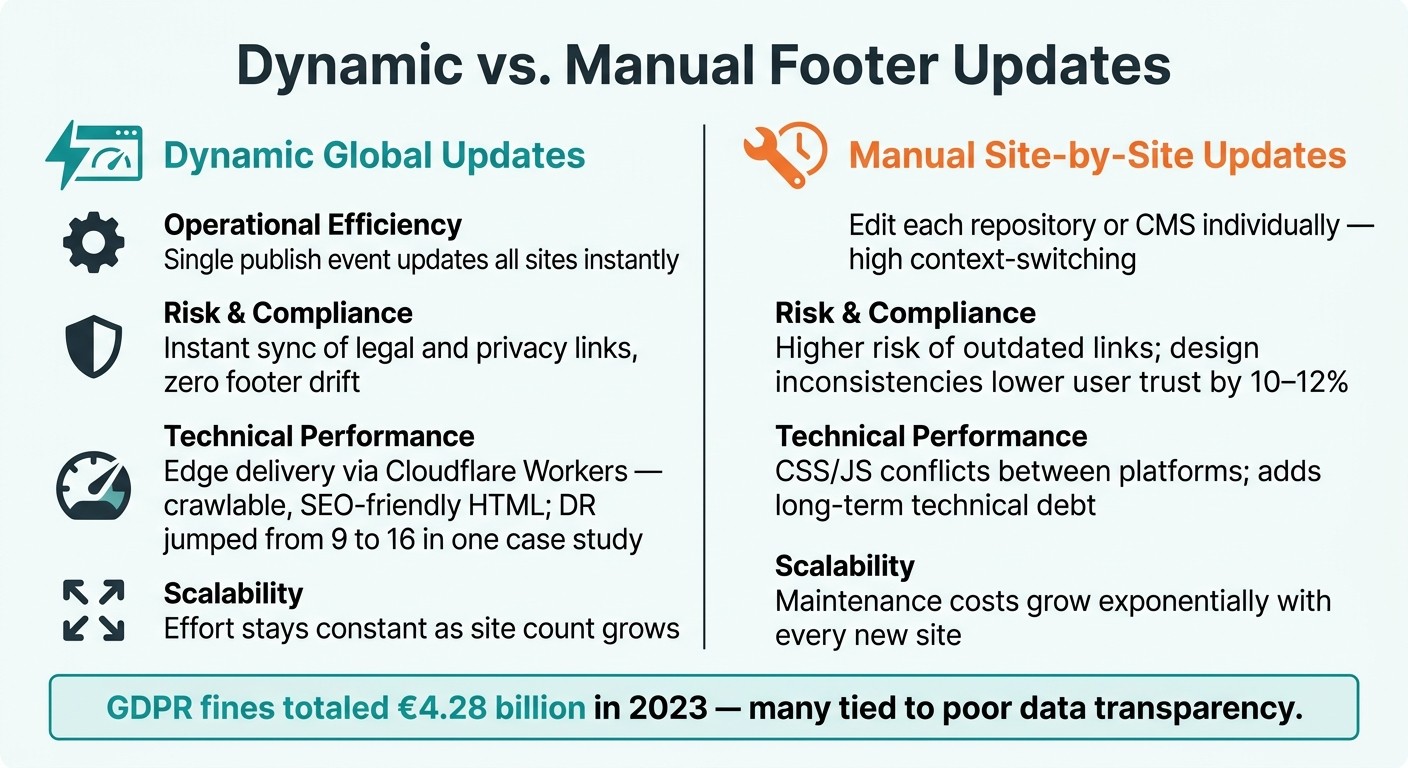
Dynamic vs. Manual Footer Updates: Key Differences at a Glance
When deciding between dynamic global updates and manual site-by-site updates, the choice often comes down to the size of your portfolio and how frequently your footer content changes. For smaller, more static portfolios, manual updates might feel manageable. But as the number of sites grows, the challenges of manual updates can escalate quickly.
Here’s a breakdown of how these two approaches compare across key areas like operations, compliance, technical performance, and scalability:
Category | Dynamic Global Updates | Manual Site-by-Site Updates |
|---|---|---|
Operational Efficiency | Updates all sites with a single publish event from one dashboard | Requires editing each repository or CMS individually, leading to high context-switching costs |
Risk and Compliance | Ensures instant sync of legal and privacy links, avoiding "footer drift" | Higher risk of outdated or inconsistent legal links across multiple domains |
Technical Performance | Uses edge delivery (e.g., Cloudflare Workers) to keep HTML crawlable and SEO-friendly | Manual updates may render quickly but often involve custom adapters, adding long-term technical debt |
Scalability | Effort remains consistent as the number of sites grows | Maintenance costs and complexity increase with every additional site or platform |
Dynamic updates clearly shine in terms of efficiency, compliance, and scalability. Manual updates, while feasible for small-scale operations, can become a logistical and technical headache as your portfolio expands. Every missed manual change introduces potential legal risks, whereas dynamic updates centralize control, ensuring consistent and accurate updates across all sites.
"1Footer moves that work into a centralized model... Instead of opening many repos and deployment pipelines, you update one governed artifact and distribute it everywhere." - Daniel Sinewe, Creator, 1Footer
Ultimately, scalability is where dynamic updates pull far ahead. With a centralized system, adding a new site becomes a straightforward process. In contrast, manual updates add layers of maintenance and increase the likelihood of errors, making them less practical for larger or rapidly growing portfolios.
Conclusion
For teams managing multiple sites, a single publish event ensures consistency across all sites, eliminating the risk of discrepancies creeping into your portfolio. As the number of sites grows, manual updates become increasingly time-consuming, while dynamic updates allow maintenance efforts to remain steady regardless of scale.
Compliance and SEO are critical considerations. Outdated privacy policies or terms-of-use links can create legal risks, while inconsistent internal links can harm search engine visibility. Centralized management ensures your legal content stays up-to-date and provides consistent, crawlable HTML.
For those managing more than just a few sites, 1Footer offers a solution tailored to this challenge. It treats the footer as shared infrastructure - managed, versioned, and verifiable - rather than static code duplicated across repositories. As Daniel Sinewe, Founder of 1Footer, explained, the tool was created because footer updates often fell out of sync across projects, leaving outdated legal and launch links on many of his sites.
FAQs
How do global footer updates work across multiple sites?
Global footer updates are now easier to manage with a centralized system that eliminates the hassle of maintaining static code on individual sites. With 1Footer, you connect your domains to a central dashboard, where you can define shared elements - like legal links - for consistent content across all sites. You can also tailor specific details for individual domains when needed. Once updates are made, they’re published just once and automatically applied everywhere, delivering crawlable HTML directly to each domain.
Will a dynamic footer hurt or help SEO?
A well-designed dynamic footer can boost your SEO by providing consistent, crawlable navigation throughout your site. This helps search engines understand your site’s structure and reinforces its authority on specific topics.
With tools like 1Footer, you can ensure your footer contains reliable, crawlable links, reducing the risk of broken internal links. However, it’s important to avoid overloading your footer with keywords or low-quality links, as this can negatively impact your SEO. Instead, focus on creating a well-structured, user-friendly footer that highlights your most important content effectively.
How can I customize one site’s footer without breaking consistency?
To adjust a single site’s footer without disrupting the uniformity across your network, 1Footer offers per-domain customization tools. These tools allow you to maintain shared elements - like legal links or navigation - across all sites while customizing specific details, such as logos, campaign links, or localized branding, for individual domains. This approach ensures that essential content remains consistent while addressing the specific requirements of each site.